Skip to content
EDUCATIONAL STUFFS
EDUCATIONAL STUFFS

An Ocean of Information

  • Home
  • SSC
    • SSC CGL
    • SSC CHSL
    • SSC JE
  • DIPLOMA
    • Engineering Drawing
    • Elements of Workshop Technology
    • Operations Management
    • Applied Mehanics
    • Strength of Materials
    • Materials Science
  • UPSC
    • Geography
  • Previous Year Papers
    • DSSSB
      • MOCK TEST
      • PAPERS
    • KENDRIYA VIDYALAYA
      • PRACTICE SETS
    • CTET
      • Assessment
      • Debates
      • Development
      • Disability
      • Emotional
      • Gender
      • Gifted
      • Inclusive
      • Intelligence
      • Kohlberg
      • Language
      • Motivation
      • Piaget
      • Socialization
      • Thinking
      • Vygotsky
  • MISCELLANEOUS
    • Road Safety
    • Multiple Choice Questions (MCQs)
      • Electrician
      • Fitter
      • Mechanic Diesel
      • Employability Skills
      • Welder
      • Workshop Calculation & Science
  • STORIES
  • About US
  • Contact Us
EDUCATIONAL STUFFS

An Ocean of Information

January 24, 2022February 12, 2025

ENGINEERING DRAWING- Conventions

CONVENTIONAL REPRESENTATION

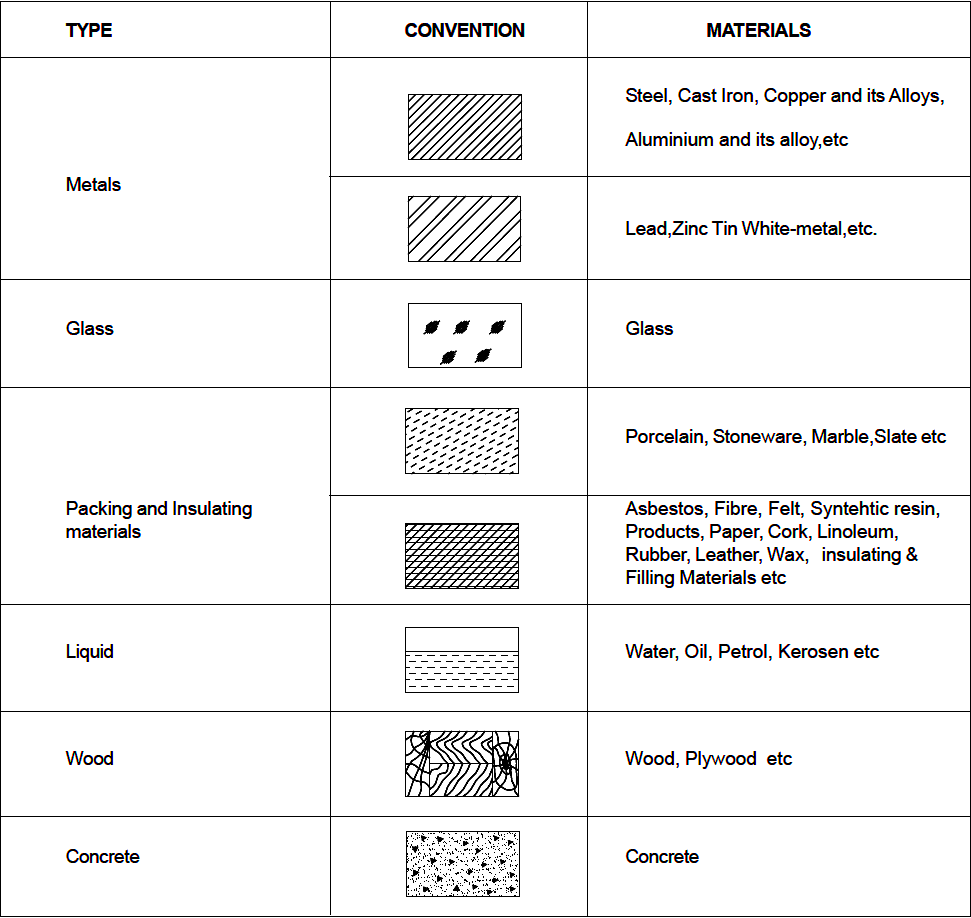
Certain draughting conventions are used to represent materials in section and machine elements in engineering drawings.

Conventional representation refers to standardized symbols, notations, and simplified depictions used in technical drawings, blueprints, and schematics. These representations help engineers, architects, and manufacturers communicate design intent clearly without excessive detailing.


MATERIALS:

As a variety of materials are used for machine components in engineering applications, it is preferable to have different conventions of section lining to differentiate between various materials.


CONVENTIONAL SECTIONS FOR MATERIALS :

Conventional sections for materials are standardized methods used in engineering and manufacturing to represent the internal structure, composition, and features of a material or component. These sections are crucial for understanding the material’s properties, ensuring quality control, and facilitating communication between designers, engineers, and manufacturers.

Cross-Sectional View

  • Purpose: To reveal the internal structure of a material or component by cutting it perpendicular to its axis.
  • Applications: Used in metallurgy, composites, and structural engineering to analyze grain structure, porosity, layering, or internal defects.
  • Types:
    • Transverse Section: Cut perpendicular to the longitudinal axis (e.g., analyzing the cross-section of a cylindrical rod).
    • Longitudinal Section: Cut parallel to the longitudinal axis (e.g., examining layers in a laminated material).
  • Representation: Shown in technical drawings with hatching or shading to differentiate materials.


RELATED VIDEOS FOR CONVENTIONS:


For More Information (Conventions)- CLICK HERE

Engineering Drawing blueprintCADconventionconvention of concreteconvention of glassconvention of insulating materialsconvention of liquidconvention of materialconvention of materialsconvention of metalsconvention of packing materialsconvention of woodconventionsdegreedimensioningdiplomadraftingdrafting toolsdrawingelectricalengineeringENGINEERING DRAWINGengineering graphicsFittergeometric constructiongeometric constructionsindustrialindustrial trainingindustrial training instituteisometric projectionITIMachinistMechanic Motor Vehiclemechanicalmechanical drawingmechanical engineeringorthographic projectionperspective drawingstandardssymbolstechnical drawingTurnervisualizationwelder

Post navigation

Previous post
Next post

Leave a Reply Cancel reply

Your email address will not be published. Required fields are marked *

Archives

Categories

Pages

  • About US
  • Contact Us
  • Legal Disclaimer
©2025 EDUCATIONAL STUFFS | WordPress Theme by SuperbThemes