
EXPERIMENT
OBJECTIVE:
To study the constructional features and working of the thermocouple used in a heat treatment furnace.
APPARATUS REQUIRED:
- Various types of Thermocouple\Pyrometer available in the laboratory.
- Screw drivers.
- Pliers etc.
THEORY:
The thermocouple/pyrometer is an instrument which is employed to measure high temperatures , usually prevalent in furnaces; these high temperatures cannot be measured by means of ordinary thermometers. Two types of thermocouples/pyrometer commonly used are:
- Thermo-electric thermocouple/pyrometer.
- Optical thermocouple/pyrometer.
THERMO-ELECTRIC THERMOCOUPLE/PYROMETER:
In its simplest form it consists of two dissimilar metals or alloys which develop e.m.f. when the reference and measuring junctions are at different temperatures. The reference junction or cold junction is usually maintained at some constant temperature, such as 0° C and the device used for measuring the temperatures. In many industrial installations the instruments are equipped with automatic compensating devices for temperature changes of reference junction, thus eliminating the necessity of maintaining this junction at constant temperature.
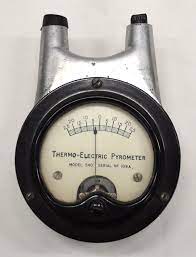
Table provides the composition, useful temperatures range and temperature versus e.m.f. relationship of some commercial thermocouples/pyrometer.
|
S. No. |
THERMOCOUPLE |
COMPOSITION |
TEMPERATURE ° C |
THERMO-ELECTRIC POWER |
REMARKS |
||
|
USEFUL RANGE |
MAXIMUM | ° C |
MILLI-VOLT |
||||
|
1. |
Platinum vs Platinum Rhondium | Pure platinum vs Pt + 10 or 13% Rh | 400 to 1450 | 1700 | 0 500 1000 1500 |
0.0 4.219 9.569 15.498 |
Used for high temperature measurements |
| 2. | Chromel vs Alumel | 90% Ni + 10% Cr vs 95% Ni + 5% (Al + Sn) Mn | -200 to 1200 | 1450 | -200 0 300 600 900 1200 |
5.75 0.0 12.21 24.90 37.36 48.85 |
High resistance to oxidation |
|
3. |
Iron vs Constantan | Pure iron vs 45-60% Cu + 55-40% Ni | -200 to 750 | 1000 | -200 0 300 600 900 |
-8.27 0.0 16.59 33.27 52.29 |
|
| 4. | Copper vs Constantan | Pure copper vs Cu – Ni constantan | -200 to 350 | 600 | -200 0 200 400 |
-5.539 0.0 9.285 20.856 |
Not suitable in air due to excessive oxidation |
OPTICAL PYROMETER/THERMOCOUPLE:
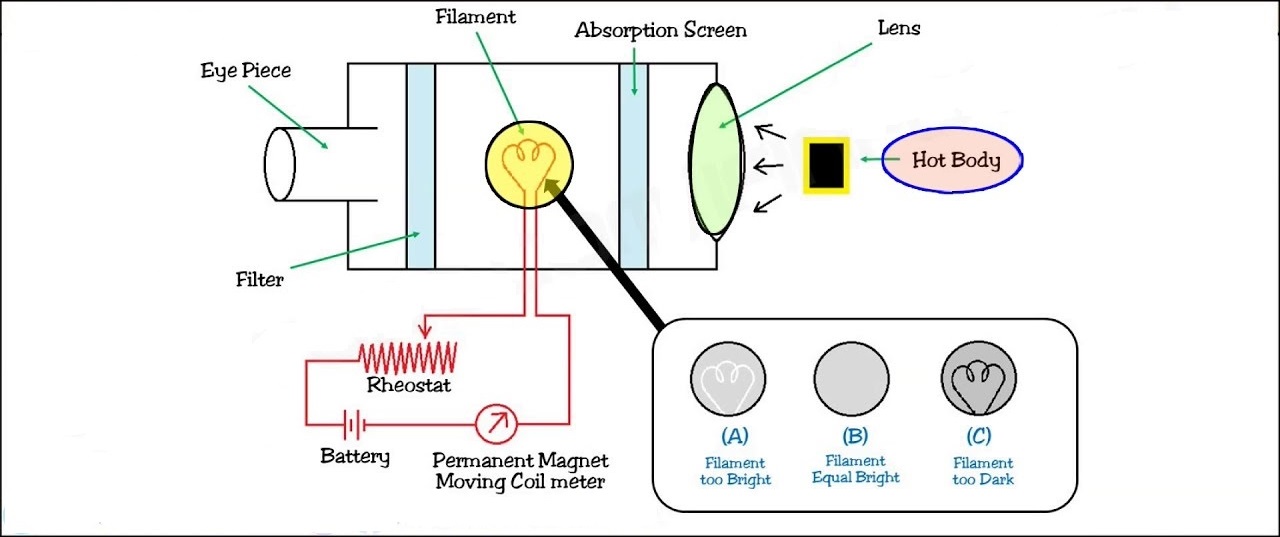
An optical thermocouple/pyrometer works on the principle that matters glow above 480° C and the color of visible radiation is proportional to the temperature of the glowing matter. The amount of light radiated from the glowing matter (solid or liquid) is measured and employed to determine the temperature.
OPERATION:
- The optical thermocouple/pyrometer is sighted at the hot body and focused.
- In the beginning filament circuit, more and more current is fed into it, till filament becomes equally bright as the background and hence disappears.
- The current flowing in the filament at this stage is measured with the help of an ammeter which is calibrated directly in terms of temperature.
- If the filament current is further increased, the filament appears brighter as compared to the background which then looks dark.
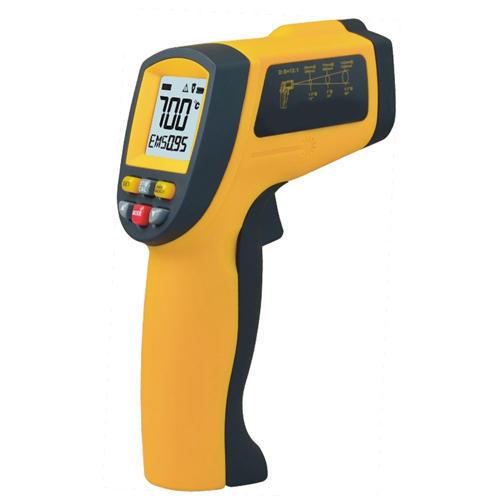
An optical pyrometer/thermocouple can measure temperature ranging from 700 to 4000º C.